
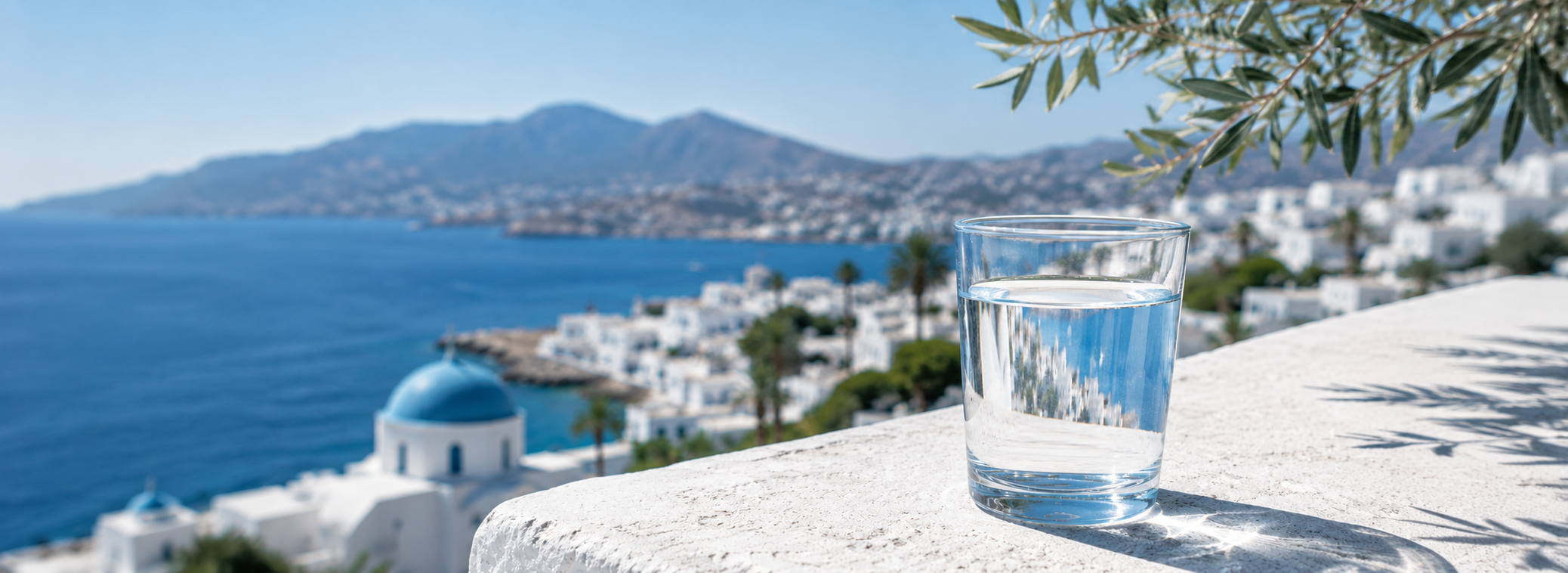
Is Tap Water Safe to Drink in Kos, Greece?
Updated 2026 · DEYAK 2024 data
Quick Answer
Tap water is safe by EU standards but tastes mineral. Most visitors prefer bottled water for drinking.
Our Suggestion
Tap for cooking, coffee & teeth. Use the bottled water provided for drinking.
Tap Water in Kos, Greece
For most of the island, tap water in Kos meets EU and Greek national safety standards and is officially safe to drink. In a small number of western zones, 2024 data shows parameters at or above regulatory limits. The longer answer for all visitors involves taste, summer supply pressures, and the practical habits of most people who spend time on the island. Understanding all three helps you make the right choice for your stay.
Who Manages Water in Kos
Water supply on Kos is managed by DEYAK (Δ.Ε.Υ.Α. Κω), the Municipal Water Supply and Sewerage Company of Kos. DEYAK operates an in-house chemical laboratory that conducts periodic testing across all distribution networks, monitoring both microbiological quality (coliform bacteria and other indicators) and chemical composition. Annual analysis reports are published on the DEYAK website and cover water quality by region across the island.
Testing follows the Greek ministerial decision JMD Γ1(δ)/ΓΠ ECO 67322/2017, which transposes the EU Drinking Water Directive into national law. Greece ranks 17th globally on water quality according to the Yale University Environmental Performance Index, with a 92% quality score, reflecting consistent compliance across the country's water utilities.
A Unified Island-Wide Network
Kos is notable in Greece for a specific reason: it is the first Greek island to operate with a fully unified, island-wide fixed water distribution network. This is not a small distinction. Many Greek islands rely on a patchwork of local systems with varying infrastructure quality. Kos has a single integrated network managed by DEYAK, supported by 12,000 smart water meters installed in households, hotels, and commercial properties across the island.
The smart metering system tracks real-time consumption and feeds into a telemetry platform that monitors water quality and distribution continuously. One measurable result of this infrastructure investment is a 30% reduction in non-revenue water, meaning losses from leakage and unbilled consumption. For visitors, this means the water reaching the tap in Kos Town and most parts of the island has passed through a relatively modern and monitored distribution system.
Where the Water Comes From
Kos draws its water from two main sources: drilled boreholes that access underground aquifers, and surface water reservoirs fed by seasonal rainfall. The island sits on limestone geology, which means groundwater naturally picks up calcium and magnesium as it moves through rock. This makes Kos water moderately to quite hard depending on the source, a characteristic it shares with much of the Aegean.
After extraction, water is treated at local facilities before entering the distribution network. During peak summer months, higher chlorination levels are used to maintain microbiological safety across the network as temperatures rise and consumption increases sharply. The taste that many visitors notice and find off-putting is largely a product of this treatment process combined with the natural mineral content of the water, not a sign of contamination.
Water Quality by the Numbers: 2024 Data
DEYAK publishes annual chemical and microbiological analyses for all distribution zones across the island. The 2024 results provide a clear, area-by-area picture.
Microbiological quality: clean across the island. Every sample taken in 2024 recorded zero total coliforms, zero E. coli, zero enterococci, and zero sulphite-reducing Clostridium. Residual chlorine at the tap ranged from 0.20 to 0.25 mg/L, meeting the minimum required for safe distribution. From a health perspective, the water is properly treated and bacteriologically sound island-wide.
Chemical quality varies by zone. The table below covers the main areas of the island (parametric limits in parentheses):
| Zone | pH (6.5–9.5) | Hardness (°dH) | Nitrates mg/L (max 50) | Chlorides mg/L (max 250) | Arsenic μg/L (max 10) |
|---|---|---|---|---|---|
| Kos Town center / Psalidi | 7.1 | 20.5 | 26 | 50 | 2.4 |
| Lampi | 7.2 | 26.7 | 21 | 237 | 2.9 |
| Zipari / Tigaki / Asfendiou | 7.4 | 20.2 | 9 | 47 | 3.2 |
| Pyli / Marmari | 6.8 | 25.0 | 19 | 168 | 3.6 |
| Antimacheia | 7.4 | 24.9 | <5 | 136 | 4.1 |
| Kardamaina | 6.9 | 33.0 | 5 | 146 | 2.4 |
| Mastichari | 7.2 | 36.4 | 6 | 288 ⚠ | 5.0 |
| Kephalos | 6.9 | 15.1 | 18 | 124 | 8.2 |
| Kamari | 7.2 | 11.1 | 0 | 106 | 12 ⚠ |
Two areas recorded exceedances in 2024. Mastichari showed chlorides at 288 mg/L, above the 250 mg/L limit, which affects taste and is a longer-term concern at high levels. Kamari recorded arsenic at 12 μg/L, marginally above the EU limit of 10 μg/L. Both areas are in the western part of the island, away from Kos Town. DEYAK is responsible for notifying affected residents when parametric values are exceeded.
For visitors staying in Kos Town, the picture is more straightforward. The center and Psalidi zone records pH 7.1, nitrates at 26 mg/L (well under the 50 mg/L limit), chlorides at 50 mg/L, and arsenic at 2.4 μg/L. All parameters are comfortably within limits. The water is hard at 20.5 German degrees, which explains the mineral taste and the white deposits that form on kettles and showerheads.
Taste and Practicalities
Safe and palatable are different things. The water in Kos is officially safe, but many visitors find the taste noticeable, particularly if they are accustomed to softer, less mineralised water at home. Locals and long-term residents commonly use bottled water for drinking while relying on tap water for cooking, washing, and general use. This is a preference, not a precaution.
For visitors with sensitive stomachs, medical advisories suggest erring toward bottled water during the first few days in any new destination, not because of contamination risk but because the mineral composition of the local water differs from what the body is used to. This applies in Kos as it does elsewhere.
For cooking, brushing teeth, making coffee or rinsing fruit, tap water is fine. For drinking throughout the day, the choice between tap and bottled largely comes down to personal preference.
Summer Water Supply
One factor that matters more than the chemistry is supply. In August 2025, DEYAK issued an urgent public notice stating that water reserves in storage tanks in Kos Town had been fully depleted. The causes were a combination of borehole damage, extreme heat, and the sharp spike in consumption that occurs when the island's population swells with tourists during peak season. Elevated parts of the island experienced the most significant disruptions. Residents were asked to limit use to essential purposes only.
This is not unique to 2025. The structural challenge of supplying a small island whose population multiplies several times over during two months of the year is significant. The smart network and efficiency improvements DEYAK has made in recent years reduce losses, but they cannot fully offset the demand surge of high summer.
For most visitors staying in Kos Town in June, early July, September or October, supply disruptions are unlikely. For those visiting in August, particularly in hillside or elevated areas, it is worth being aware that supply can be intermittent during peak heat.
What Visitors Typically Do
In practice, most visitors to Kos drink bottled water. It is inexpensive and available everywhere. The larger supermarkets on Averof and Kanari streets stock a full range, and smaller mini-markets throughout Kos Town carry it in single bottles and multi-packs. Many accommodation providers, including Koasis Boutique Apartments, include bottled water as a welcome amenity on arrival.
Tap water remains the practical choice for everything other than drinking. Running a cold tap while cooking, making Greek coffee in the morning, and rinsing produce is standard practice across the island. The water quality at the point of delivery is consistent with what you would expect from an EU-regulated utility.
Practical Notes
- Tap water is officially safe and meets EU drinking water standards.
- Taste is the main reason locals and visitors prefer bottled water, not safety.
- Summer supply can be constrained in August, particularly in elevated areas and during heatwaves.
- For drinking: bottled water is the comfortable default, widely available and affordable.
- For cooking, cleaning and general use: tap water is perfectly appropriate.
- Public fountains in Kos Town meet safety standards but maintenance varies; bottled water or a refillable bottle is more reliable for day trips.
🏨 Koasis Boutique Apartments are located in the centre of Kos Town, steps from the main shopping streets where bottled water and groceries are available within a two-minute walk.
Sources
- DEYAK — Δημοτική Επιχείρηση Ύδρευσης Αποχέτευσης Κω — annual chemical and microbiological analysis reports, 2024 data, and public notices including the August 2025 supply alert
- EU Drinking Water Directive 2020/2184 — the regulatory framework that defines parametric limits for pH, nitrates, chlorides, arsenic and other parameters
- Yale Environmental Performance Index — Sanitation & Drinking Water (2024) — Greece's 17th global ranking and 92% water quality score
KOASIS
Planning a stay in Kos?
Stay in the heart of Kos Town
11 smart boutique apartments, just minutes on foot from the beach, Old Town and ferry ports. Fully equipped spaces, a smarter stay with the Koasis app, and personal assistance whenever you need it.
 5 Stars
 Featured
 Exceptional
 Excellent