Kos vs Rhodes: Which Greek Island is Better?
Rhodes is the obvious answer. Larger, more famous, with a UNESCO-listed medieval town that appears on every list of the best places in Greece. When people ask which island to choose between the two, Rhodes is where most of the internet sends them.
This article makes a different argument. Rhodes is not a bad choice. But for a specific kind of holiday, Kos does things better. The comparison is worth going through properly, because the choice matters more than people usually treat it.
Size and What It Actually Means
Rhodes is five times the size of Kos. That sounds like an advantage, and in some ways it is. More ground means more variety: different landscapes, more beaches to choose between, more towns worth visiting. If you want to spend two weeks driving around an island with a different stop each day, Rhodes accommodates that in a way Kos cannot match.
But size has a cost for the average one-week visitor. Rhodes is too large to feel like you have seen it from a single base. The medieval Old Town in the north and Lindos on the east coast are both excellent, but they are 50 kilometres apart. Getting between the main draws requires either a hire car, organised excursions, or accepting that you will only cover part of the island.
Kos has a different logic. The island is long and narrow, mostly flat, with Kos Town at the northeastern tip. It is a proper base: the best beaches run along the north and south coasts, between 10 and 30 kilometres away, and the flat terrain makes them easy to reach by bike. You can cover Kos properly in a few days, which is not something every visitor to Rhodes can say.
The Beaches
Both islands have excellent beaches. The distinction is less about quality and more about character and accessibility.
Rhodes is known for the beaches along its east coast: long stretches of pale sand near Faliraki and further south around Prasonisi, where the island's tip splits into two beaches simultaneously facing the Aegean and the Mediterranean. Tsambika and Lindos beach are both genuinely good. The west coast is rougher and windier, less useful for swimming.
Kos has a different spread. The north coast runs along a calm shallow bay, with Tigaki and Marmari offering long sandy beaches that are easily reached by bike from Kos Town. The south coast is more dramatic: Paradise Beach, Camel Beach and the long sandy arc toward Kefalos are sheltered, with water that sits in the high twenties through the summer months.
The advantage Kos holds here is cycling access. The coastal path running from Kos Town along the north shore is a genuine pleasure, and renting a bike to reach the beach turns out to be more practical and more enjoyable than most visitors expect. In Rhodes, the distances and the terrain make cycling to beaches a much more limited option.
Kos Town vs Rhodes Town
This is the sharpest contrast between the two islands, and arguably the most important one for visitors who care about where they are actually based.
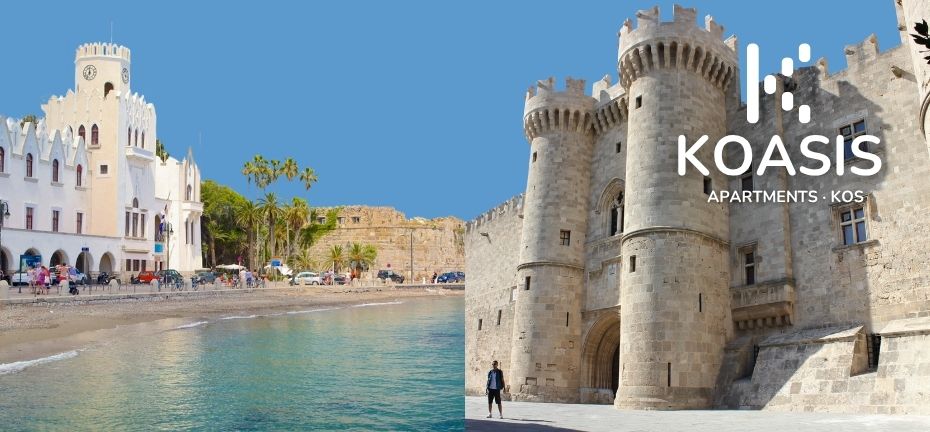
Rhodes Old Town is extraordinary. The medieval walls, the Street of the Knights, the mosques and palaces layered into the Ottoman and Italian architecture combine to make one of the most remarkable historic centres in the Mediterranean. The UNESCO designation is deserved. If you want to walk through living medieval history, nothing in Kos comes close.
The limitation is that Rhodes Old Town is crowded, and increasingly built around its own tourism. The cobbled streets that look quiet in photographs are shared, in peak season, with thousands of other visitors moving between the same restaurants and the same shops. The old town becomes a managed experience as much as a place people actually live.
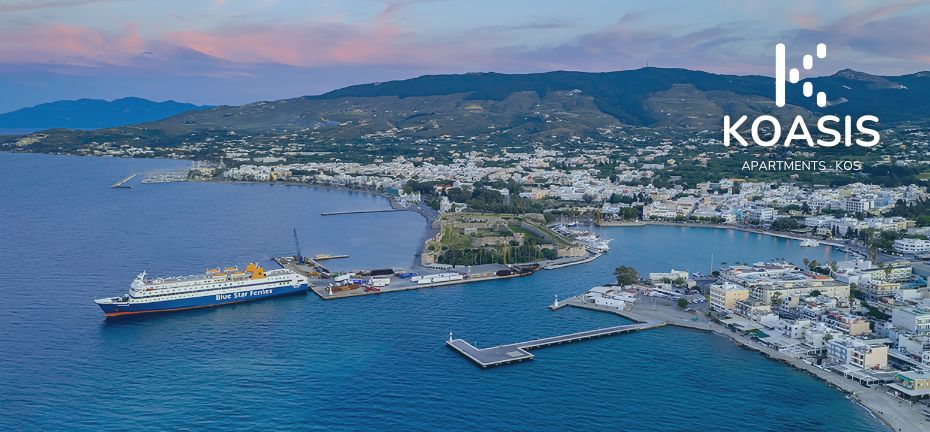
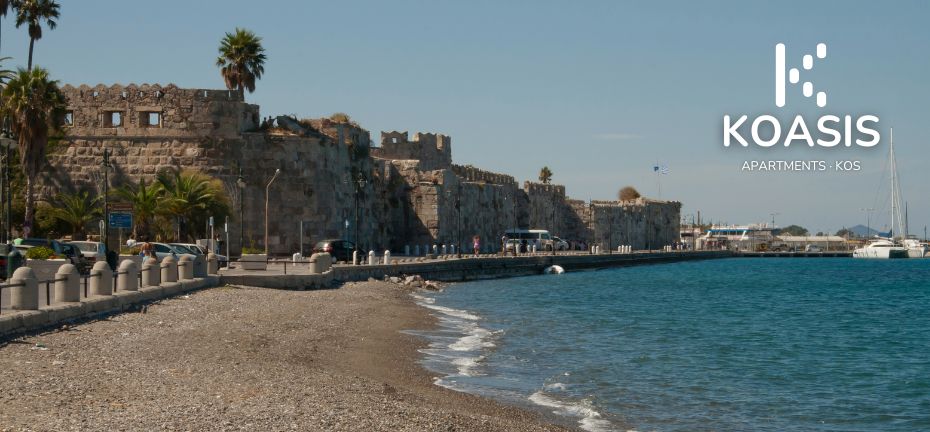
Kos Town is a different kind of historic centre. Ancient ruins sit in the middle of the city: the ancient agora, the plane tree of Hippocrates, the Neratzia Castle on the harbour. The town around them functions as a real place. There are local cafes, a morning market, residential streets, a harbourfront that belongs to the town as much as it does to its visitors. The archaeological layers are remarkable in their own right: Hippocrates, the father of medicine, was born here, and the Asklepion a few kilometres outside town is one of the most significant healing sanctuaries of the ancient world.
For a stay of a week, being based in Kos Town rather than Rhodes Old Town gives you a place that feels like somewhere rather than a backdrop.
Book your stay at KoasisCrowds
Rhodes receives roughly three million visitors per year. Kos receives around one million. The difference is visible on the ground.
Faliraki, Rhodes's main resort town, is one of the largest and most heavily developed resort strips in Greece. The rest of the east coast follows a similar pattern: resorts, water parks, organised beach clubs, package holiday infrastructure at full capacity through July and August.
Kos has resort areas too. Kardamena is a package-holiday town on the south coast, and there are resort strips along the north coast between Tigaki and Marmari, but they don't define how the island feels. The nightlife concentrates on the bar street in Kos Town itself, not sprawled across a dedicated resort zone. Kos Town remains a real town. The cafes around the castle are busy but not unmanageable. The streets of the old quarter are walkable. The harbour, even in August, does not feel like a theme park.
For travellers who want a Greek island rather than a Greek resort, this matters.
Getting There
Rhodes has the edge here. It is one of the busiest airports in Greece, with direct connections from most northern European cities throughout the summer. Frequency is higher and the season is longer than almost anywhere in the Aegean.
Kos is well-connected but not quite at the same level. Direct flights from the UK, Germany, Scandinavia and the Netherlands run from April through October, with good frequency in summer. The airport sits roughly in the centre of the island, around 25 kilometres southwest of Kos Town. Transfers by taxi or shuttle take around 30 to 40 minutes.
If flight connections are a significant factor in your decision, Rhodes has a practical advantage. If you are flying from one of the major departure points with direct Kos service, the difference is minimal.
Cost
Neither island is cheap by the standards of Greek tourism a decade ago. Both have seen significant price increases, and both charge at a level reflecting their international appeal.
Rhodes, being larger and more developed, has a wider price range. There are budget options in the resort areas and genuinely expensive options in Rhodes Old Town and Lindos. The middle of the market is broad.
Kos sits slightly lower across equivalent categories. Kos Town accommodation, dining and day-to-day costs tend to run a little more affordable than comparable options in Rhodes Old Town. The gap is not dramatic, but it is consistent.
Day trips from Kos offer something that Rhodes cannot match. Kos sits in the heart of the southern Dodecanese, with islands close in every direction. The crossing to Bodrum on the Turkish coast takes around half an hour and costs very little. Nisyros, the active volcanic island, is 45 minutes by ferry and unlike anywhere else in the region. Kalymnos, Leros, and Patmos are all reachable in a day. From Rhodes, the equivalent excursions are fewer and the crossings considerably longer.
Who Should Choose Rhodes
The case for Rhodes is straightforward. If you want to spend serious time in a UNESCO-listed medieval town, Rhodes Old Town is in a different category from anything in the Dodecanese, including Kos. If you want the widest variety of beaches, landscapes and villages from a single island, Rhodes accommodates that. If you are travelling with a group that wants different things from a holiday, between history, resorts, nightlife and rural landscapes, Rhodes's size means there is space for all of it.
If you have never been to Greece before and want a single island that gives you the full range of what the country offers, Rhodes makes a reasonable first choice.
Who Should Choose Kos
Kos works better for travellers who want a specific experience rather than a general one.
If you want to be based in a real town, with ancient history underfoot and a harbour that belongs to the place as much as to its visitors, Kos Town is the better base. Kos is genuinely the cycling island of the Dodecanese. If cycling interests you, the flat terrain and the coastal path make for a holiday that feels active without demanding effort. If the quality of the water and the south coast beaches matters more than the number of them, Kos delivers in a way that Rhodes, with its windier west coast and more developed east, does not consistently match.
And if the idea of spending a day on Nisyros appeals to you, standing in the crater of an active volcano and returning to Kos for dinner, that excursion alone is difficult to replicate from anywhere else in the Aegean.
Book your stay at KoasisThe Honest Answer
Rhodes is the bigger and more famous island, and the fame is not without basis. But bigger and more famous does not mean better for every traveller.
Kos is the right choice for the visitor who wants to know an island properly in a week: a good town to come back to each evening, accessible beaches, a flat landscape built for exploring at your own pace, and some of the most interesting day-trip options in the Aegean sitting just offshore.
The question is not really which island is better in the abstract. It is which one suits the kind of holiday you want to have.